


In recent weeks, relations between Nigeria and the United States have entered a period of heightened tension. U.S. President Donald Trump has sharply criticized the Nigerian government, accusing it of neglecting widespread attacks on Christians in the country. Citing claims of a “Christian genocide”, he instructed the Department of Defense to prepare for possible actions, even threatening military intervention, and reinstating Nigeria on the U.S. list of “countries of particular concern” for alleged violations of religious freedom.
Nigerian President Bola Tinubu moved quickly to address the concerns, acknowledging the dire security challenges faced by the country, but also highlighting that most attacks are not driven by religious motives. Indeed, framing the violence solely along religious lines risks underplaying the complex realities on the ground. With a population of more than 230 million, almost equally split between Muslims and Christians, the country faces several overlapping crises that cut across communal, economic, and regional lines.
Echoing this, the Nigerian Minister of Information, Mohammed Idris Malagi stressed that attacks by violent extremists target both Christian and Muslim communities alike. Armed groups such like Boko Haram and the Islamic State affiliate in West Africa Province (ISWAP) exploit local vulnerabilities, with most attacks occurring in the Muslim-majority north.
The country finds itself in a vicious cycle in which deep vulnerabilities set the conditions for armed groups to thrive and, in turn, escalating violence weakens the social and economic infrastructures needed to restore stability. To address these challenges, the government has floated several security reforms. For example, it is considering introducing community policing, a strategy that would deploy police forces in their communities, where they understand local dynamics, enabling them to provide adequate response.
The overlapping threats have displaced millions, disrupted farming, and contributed to soaring food insecurity. Civilians caught between militants and security forces often face forced evictions, arbitrary arrests, and loss of livelihoods that push entire families into instability.
Malik Samuel, a senior analyst at Good Governance Africa, argues that instability is closely linked to the chronic lack of social infrastructure, including hospitals, schools, and roads. He advocates for a greater role for local governments to address these shortcomings, especially in more peripheral areas where central authorities struggle to maintain a presence.
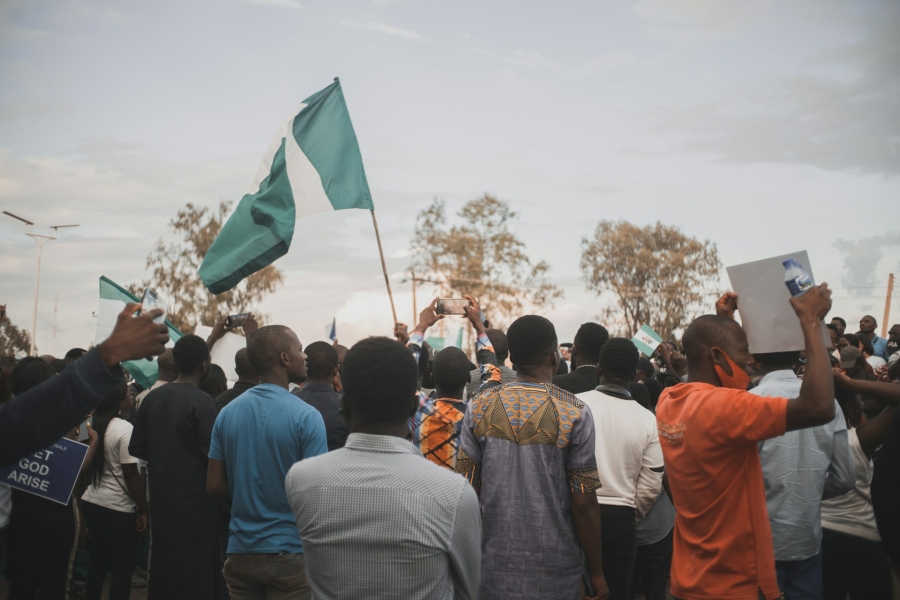
The Nigerian leadership finds itself in a difficult and precarious situation. On the one hand, it must deal with the inflammatory narrative brought forward by Trump, on the other, it is facing growing scrutiny on the internal front, with citizens criticising its inability to protect them from armed groups. Still, officials continue to express interest in deepened collaboration with Washington, arguing that lasting solutions will require coordinated security reform, sustained diplomacy, and community-level trust-building.
Ultimately, Nigeria’s crisis cannot be reduced to a religious binary. It is a multidimensional conflict landscape in which civilians, as often happens in conflict situations, remain the most vulnerable. For them, the urgency lies in restoring safety, dignity, and stability across the country’s diverse communities.


