


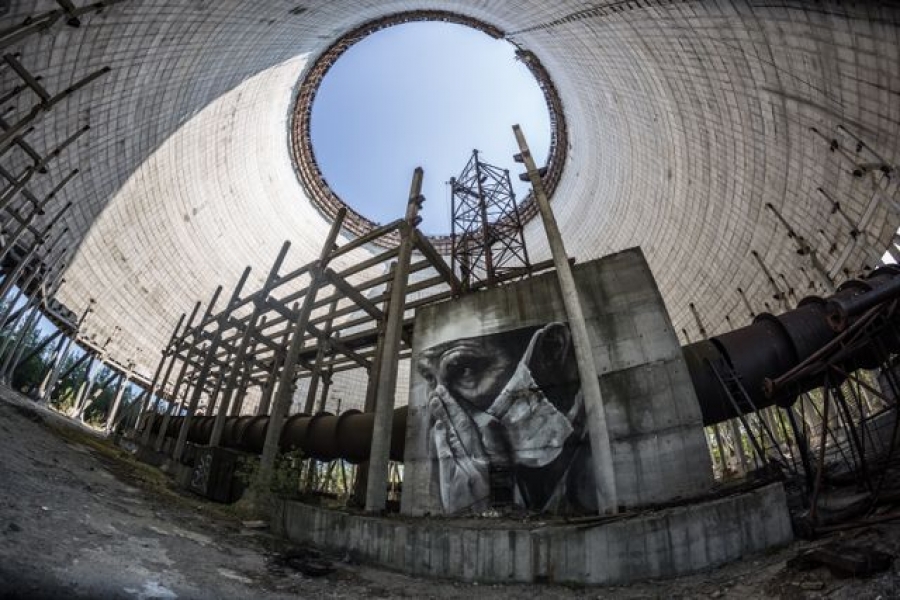
On 9 September 2026, Alexander De Croo, Administrator of the United Nations Development Programme (UNDP), visited Ukraine, making a key stop at the Chornobyl nuclear power plant. He entered the protective structure above reactor four, the one destroyed in 1986, and assessed first-hand the damage caused by recent Russian drone strikes.
In the days leading up to his visit, as reported by the Kyiv Post, anti-drone nets were installed around the Chornobyl area and near the border with Belarus. Similar structures were previously used along the roads of frontline regions to protect civilians and military transports from attacks by Russian first-person-view (FPV) drones; however, these structures would offer little protection to the Chornobyl area if Russia decided to strike it using Shahed-type drones, which mount significantly heavier warheads and have been used more and more frequently in the past two years in Ukraine.
During De Croo’s visit, military personnel stationed at the site reported several drones flying directly over the facility. In response, UNDP chief stressed the urgent need for a formal investigation to determine the origin of these drones, calling any potential strike on the plant “a gamble with the safety of millions of people”, emphasising that nuclear facilities must never be targeted, whether through a deliberate strike or collateral damage, and that there can be no ambiguity regarding this principle.
Already back in February 2026, Russian attacks against critical infrastructure severed power lines connecting Ukraine to neighbouring countries, resulting in the shutdown of a unit at an operational power plant and causing the Chornobyl site to experience a complete loss of off-site power for about an hour. While the temporary power loss at the site did not result in immediate danger, it compromised the plant's nuclear safety by forcing the cooling system to rely on backup generators, which are only designed for short-term emergency use. Following those incidents, Director-General of the International Atomic Energy Agency (IAEA), Rafael Grossi, warned of the ever-present risk to nuclear safety that might be caused by the deteriorating conditions of the grids, and called for maximum military restraint in the area.
However, as detailed in reports by the Office of the UN High Commissioner for Human Rights (OHCHR), the risks associated with grid degradation extend far beyond technical concern for the nuclear facilities, representing a deliberate threat to civilian survival. The report documents how coordinated strikes on energy infrastructures trigger a series of blackouts that impair services needed to sustain human life. Without reliable grid power, municipal heating networks stop functioning during sub-zero temperatures, while electric water pumps fail, cutting off clean drinking water and sewage management for millions of urban residents. The OHCHR further highlights how power instability paralyses electrified public transport and logistics networks, while severely undermining health and education systems. Hospitals are forced to ration electricity and use diesel generators for life-support systems, surgery units, and cold-chain storage for critical medications, while schools face prolonged shutdowns. The report highlights that strikes on power infrastructure do not just create isolated nuclear emergencies, but systematically disrupt the daily conditions necessary for civilian life.
As a response to these systemic risks caused by the war, Ukrainian authorities, with the support of Lithuania and Japan, and the technical expertise of UNDP personnel, have developed a new solar power plant that will provide continuous electricity to the cooling system of reactor four, and, during his visit to Chornobyl, De Croo took part in its inauguration. This project grants the site localised energy independence, making sure that the nuclear power plant is isolated from the national power grid, preventing future blackouts caused by Russian strikes. This measure not only protects the site from possible nuclear emergencies, but also shields the civilians from potential radiation leaks if ongoing attacks disable external power. In addition, the new solar power plant generates over 2 million kWh of clean power annually, saving around $365,000 every year that can be reinvested in further nuclear safety and civilian protection measures, and, thanks to this support, 6.6 million people now have access to electricity.
This project aligns with UNDP’s broader strategy in Ukraine. Over the past four years, the agency has mobilised 1.3 billion dollars for Ukraine, focusing the funds primarily on restoring the country’s energy infrastructure; but rather than simply rebuilding what was previously there, the agency is trying to gradually shift Ukraine towards a sustainable, decentralised energy grid, making it far more difficult to disable with a single strike. In conclusion, UNDP plans to maintain its long-term support for Ukraine, refusing to postpone reconstruction until after the end of the war. As of today, more than 600 billion dollars have been spent to repair the damage caused by the war, and De Croo, during his visit, stated his commitment to support the restoration of infrastructure in Ukraine, despite the continuous attacks by Russia. He placed urgent focus on the civilian toll, emphasising that energy grids are not just power supplies, but vital lifelines for heating, hospitals, and clean drinking water. De Croo, in his remarks, firmly condemned ongoing attacks on civilian targets, stating that 'civilians are not military targets' and demanding an end to deliberate strikes on places where ordinary people live their daily lives.


