


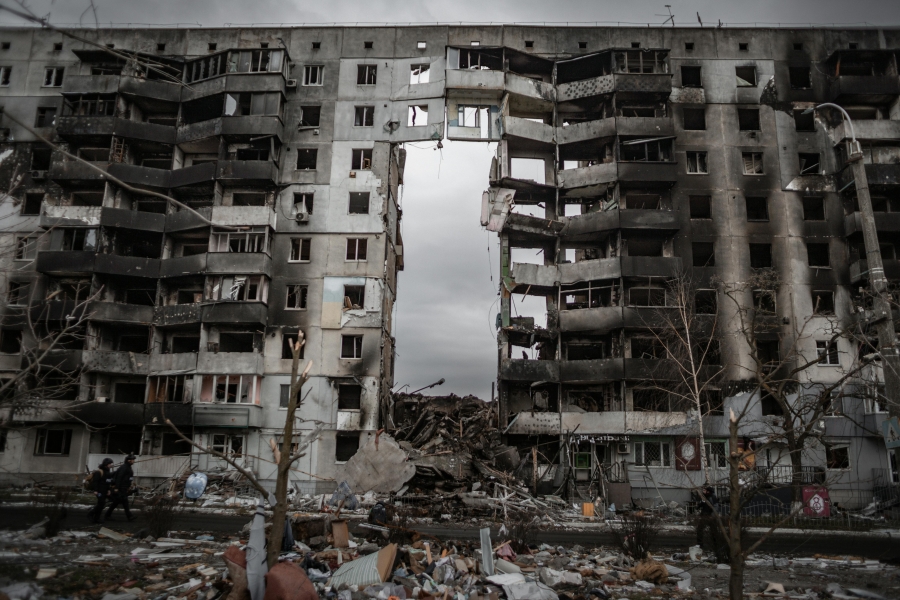
New research by Action on Armed Violence (AOAV) uncovers major underreporting of information on the type of explosive weapons used in populated areas affected by conflict. In Ukraine, Gaza, Sudan and Myanmar, public coverage often fails to identify the weapons used to harm civilians. This raises serious concerns about transparency, access to information, and accountability in conflict reporting.
Explosive weapons are one of the major causes of civilian harm in today’s armed conflicts. These weapons include air-dropped bombs, ground-launched munitions, artillery, and improvised explosive devices (IEDS). Under international humanitarian law, their use in urban or populated areas is restricted because of their wide and indiscriminate effects for civilians. In 2022, an important step forward came with the adoption of a Political Declaration on Explosive Weapons in Populated Areas, highlighting the need for strengthening accountability and adherence to international humanitarian standards.
To examine the scale of the reporting gap, researchers Timothy Barnes and Iain Overton from AOAV analysed more than 10,000 English-language articles covering the conflicts in Ukraine, Gaza, Sudan and Myanmar between 1 January 2022 and 15 November 2025. They observed how often reports identified the specific type of explosive weapon, providing a basis for understanding how frequently explosive weapons were made visible or obscured in media coverage. The investigation found that this precise information appeared in only a small minority of published articles.
In Ukraine, around 16% of reports named a specific weapon, making it the conflict where the clearest picture emerges among the other contemporary conflicts. The most frequently cited systems, including the S-300 missile, Shahed drones, and the Iskander ballistic missile, are all linked to Russian manufacturers or supplied by Iran.
On the contrary, in Gaza, Myanmar and Sudan, weapon identification drops to as low as 1-3% of reports, marking a staggering contrast. One of the explanations for this difference is that supply chains in these conflicts are largely opaque, and in Sudan's case, arms continue to flow in violation of an existing UN embargo on Darfur. This indicates that the lack of attribution is not accidental, but rather reflects an attempt to obscure the origin of these weaponry systems.
Across the four conflicts, AOAV recorded more than 114,000 civilian casualties, including over 50,000 deaths, all caused by explosive weapons used in residential areas. Yet in the vast majority of cases, the weapons behind those casualties were never publicly identified, suggesting a serious gap in the data available on explosive violence overall.
Without knowing which weapons were used in a specific attack, it is not possible to trace them back to the manufacturers and governments that supplied them. That makes it much harder to challenge arms deals, enforce embargoes, or pursue legal accountability for civilian harm. It also allows patterns of violations of IHL to continue with limited scrutiny. In other words, this underreporting undermines efforts to restrict the use and transfer of explosive weapons in urban or populated areas, making it difficult to prevent and reduce civilian suffering in armed conflicts.
To address this gap, the researchers called for stronger investment in documentation and verification. Journalists, local monitors, and civil society groups working in conflict zones need greater access to training in weapons recognition, open-source investigations, and post-strike assessment methods. At the same time, media organisations and donors should support long-term investigative partnerships that bring together reporters, technical specialists, and humanitarian researchers.
Combining these skills would contribute to identifying weapon systems, tracing supply networks and strengthening public reporting, thus helping to break the cycle of impunity and opacity surrounding the transfer and use of explosive weapons that harm civilians.


