


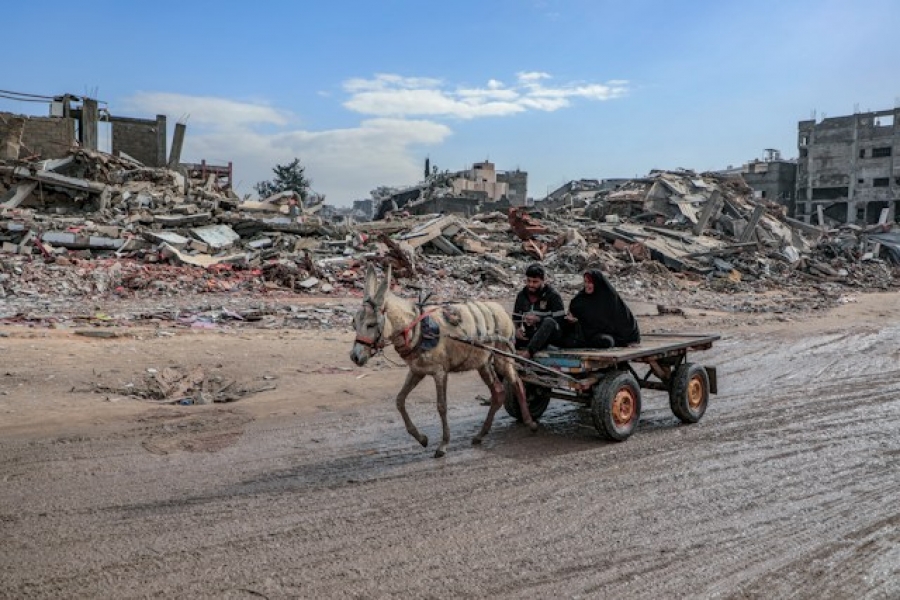
The displacement crisis in the Gaza Strip continues to worsen, despite the ceasefire. In an alert issued on 30 October 2026, the Office of the United Nations High Commissioner for Human Rights (OHCHR) denounced the progressive shrinking of space accessible to Palestinians, as Israeli military operations continue to trigger further displacement.
According to the same OHCHR report, Israel reportedly intends to expand its military deployment zone to cover 70% of the territory. The expansion of military positions westward notably in Al Shujaiyeh, Al Bureij, Deir Al-Balah, and Al Maghazi has led to further displacement. In Al Shujaiyeh, attacks on camps for displaced persons reportedly caused the displacement of 200 families, approximately 800 people, primarily women, children, and the elderly.
The humanitarian situation remains a major cause for concern. The latest data from the United Nations Office for the Coordination of Humanitarian Affairs (OCHA), published in November, highlight new challenges brought on by heavy rainfall, which has flooded several displacement sites and damaged makeshift shelters. As of 8 November, more than 26,000 households had reported damage to their shelters or belongings. Approximately 1.4 million people were still living in tents or precarious facilities, exposed to the cold and harsh weather.
The security situation also remains unstable. On November 18, a new Israeli ground operation in central Gaza beyond the "yellow line" reportedly led to the flight of thousands of Palestinians. According to information reported by The Guardian and Reuters on November 19th 2026, approximately 6,000 people left the affected area. These developments illustrate the fragility of the ceasefire and the persistence of forced displacement.
Such practices raise serious questions under international humanitarian law. Article 49 of the Fourth Geneva Convention prohibits the forcible transfer or deportation of protected persons from occupied territory, with the exception of strictly defined circumstances involving their safety or imperative military reasons. Article 53 also prohibits the destruction of private or public property, except where such destruction is rendered absolutely necessary by military operations. The Rome Statute of the International Criminal Court classifies the unlawful transfer or deportation of protected persons as a war crime. When the necessary legal criteria are met, the forced transfer of a population may also constitute a crime against humanity.
The Office of the United Nations High Commissioner for Human Rights (OHCHR) reiterates that Israel, as an occupying power, must end forced transfers and ensure the safe and dignified return of Palestinians to their places of residence. Other states also have an obligation to respect and ensure respect for the Geneva Conventions in accordance with Common Article 1 which includes taking the necessary measures to prevent grave breaches of international humanitarian law. For their part, private enterprises must respect human rights in line with the UN Guiding Principles on Business and Human Rights by preventing any adverse impacts to which their activities might contribute.
Our analysis thus reflects the appeals from humanitarian organizations and international mechanisms to ensure unimpeded humanitarian access specifically for the delivery of tents, construction materials, medicines, and essential equipment. The protection of civilians, the preservation of infrastructure vital to their survival, and the assurance of a voluntary, safe, and dignified return must remain priorities. Without effective guarantees regarding security, freedom of movement, and respect for international law, a ceasefire cannot ensure lasting protection for the Palestinian population.
By Gael MOUTELI


