


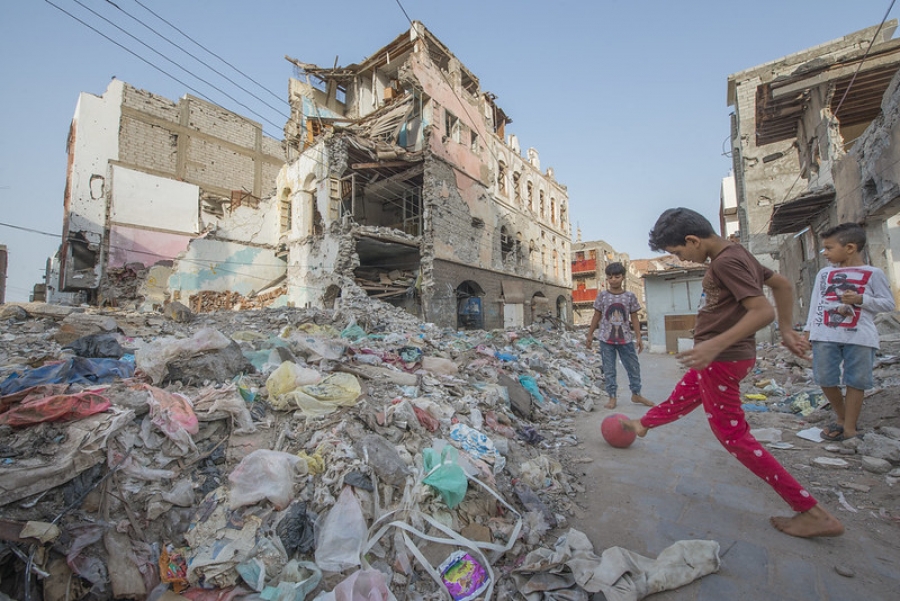
The humanitarian crisis is worsening each day in Yemen, as the system hasn’t been able to bounce back.
The United Nations Office for the Coordination of Humanitarian Affairs (OCHA) reports that among those that require humanitarian assistance, children and women are 75%. Half of all children under the age of 5 are acutely malnourished. 75% of three- and four-year-olds did not receive all the necessary vaccines, aggravating the risk of the spread of infectious diseases.
Humanitarian workers ask for more funding to get the resources needed. Furthermore, they call that the political decisions to reduce the conflict’s risk of exploding are taken considering their effects on civilians. For example, any disruption of the pipeline would reduce the already few energy resources for the Yemeni communities. In September 2024, the UN reported that the political situation in Yemen risked going back to a crisis, despite the efforts of the de-escalation agreements.
The crisis is rooted in the Arab Spring of 2011. The consequence was that in 2012, the authoritarian president Al Abdullah Saleh gave the key of the power to Abdrabbuh Mansour Hadi, his deputy. The aim was to stabilize the country. However, this dream was destroyed in 2014, with the Houthi Shia Muslim Rebellion. The movement managed to take control of the northern province of Saada and later of Yemen’s capital, Sanaa. A year later, the conflict escalated again because of the air strikes against the Houthis to restore Mr. Hadi’s government. This operation involved not only Saudi Arabia, which led the coalition of eight Sunny Arab states, but also the western international community, namely U.S, UK, and France. According to Saudi Arabia, the Houthi fighters, whose aim was to gain independence, were receiving help from Iran, which on the contrary denied. Since then, there has been a humanitarian crisis due to the conflict itself but also because of the destruction of the health system. Humanitarian aid managed to enter the country only in June 2018, when the coalition seized control of the port of Hudaydah. A truce was reached only in 2023, but the actual difficulties didn’t end. 18.2 million people are now in need of humanitarian aid and protection.


