


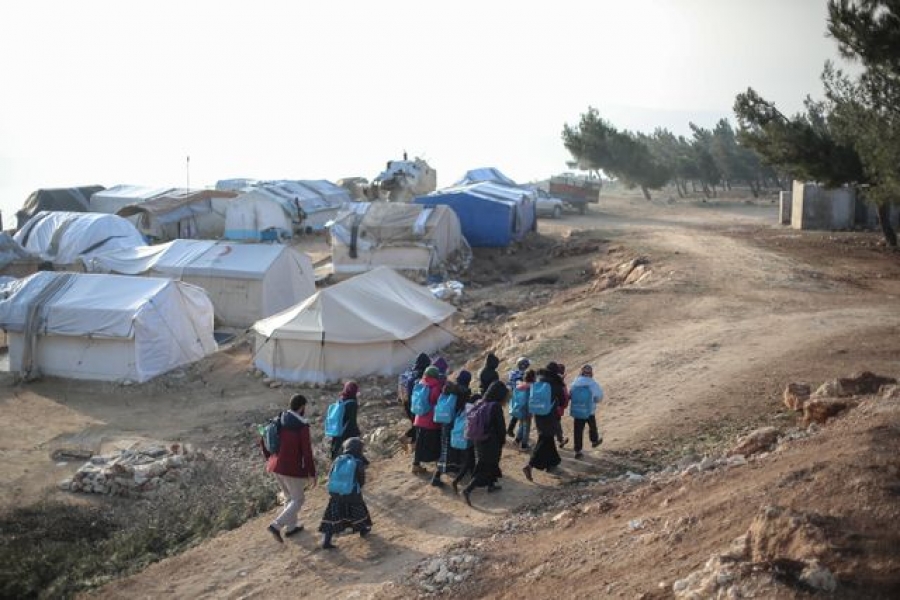
By the end of 2025, an estimated 117.8 million people globally were forcibly displaced as a result of conflict, violence, persecution, and human rights violations. While the vast majority was forcibly displaced within national borders, 41.6 million were refugees and other people in need of international protection across borders. The latest UNHCR Global Trends report, published in June 2026, shows that while global displacement numbers declined slightly, the situation remains structurally severe and a long-term challenge. On World Refugee Day, these findings underscore the urgency of moving beyond emergency responses and creating conditions that enable refugees to rebuild their lives in dignity and security.
General global trends
In 2025, forced displacement remained highly concentrated and persistent, driven largely by a small number of long-term and protracted crises that do not leave any options for millions of people to return home. In fact, data shows that more than seven in ten refugees and other people in need of international protection came from just six countries: Afghanistan, South Sudan, Sudan, Syria, Ukraine and Venezuela, where conflict and crises run over time.
Almost 5.4 million people were forced to flee during the year, predominantly to neighboring countries affected by the same regional crises. Currently, the largest refugee-hosting countries included Colombia, Germany, Turkey, Uganda, Iran, Chad and Pakistan, indicating that most displaced people remain close to their regions of origin, particularly in Global South countries. A troublesome pattern is that almost 40 per cent of refugees are children, with significant consequences for education, well-being and future opportunities for the most vulnerable.
In 2025, ongoing conflicts and conditions of insecurity trapped populations within national borders, in Colombia, DRC, Syria, Yemen and Afghanistan, while Sudan recorded the largest internally displaced population globally, with 9.1 million people. Climate-related disasters were also a major driver of new global displacement, mostly triggered by storms, a factor that is increasingly adding pressure to already vulnerable and fragile contexts.
The report also assesses that an estimated 4.5 million people were stateless worldwide, a slight increase compared to the previous year. A significant share of this population was Rohingya, many of whom were forced to flee Myanmar and seek safety in Bangladesh due to ongoing conflict and persecution.
Returns of displaced people increased substantially, with around 14.7 million total returns, including 10.3 million internally displaced people and 4.4 million refugees who came back to their countries or areas of origin. This is the case in particularly for Afghan, Syrian, Sudanese and Ukrainian refugees. However, these returns often took place in highly precarious conditions. Many returnees faced severe protection risks such as gender-based violence, forced recruitment, extortion and exploitation, and frequently returned to areas still affected by active conflict or relocated to places with limited or no humanitarian assistance. In many cases, they lacked access to basic services, infrastructure and housing, and economic opportunities for rebuilding their life remained extremely limited.
A challenging geopolitical context
Beyond these figures, the broader geopolitical context further complicates return, protection and reintegration pathways. The 1951 Refugee Convention and the Global Compact on Refugees are under growing political strain, with some states, like European countries and the United States, having introduced more restrictive asylum policies or limiting access to protection procedures.
This has coincided with rising anti-refugees’ sentiment, a global humanitarian funding crisis affecting over 122 million displaced people, and continued pressure on Global South countries, which host around 75 per cent of the world’s refugees despite more limited resources. While returns rates are often presented as a sign of success, they increasingly occur in contexts where both conditions in countries of origin and the international protection system itself remain under significant distress.
UNHCR recommendations
To address these structural challenges, UNHCR chief Barham Salih calls for a shift towards durable solutions that go beyond returns and reduce reliance on humanitarian assistance over time. This aligns with the “50 by 35” vision, which aims to reduce by more than half the number of refugees in prolonged displacement dependent on humanitarian aid over the next decade.
Voluntary return remains the preferred solution where it is safe, informed, and sustainable, but it depends on conditions in countries of origin. Investment in housing, basic services, livelihoods, and infrastructure are needed to ensure sustainable reintegration.
In host countries, solutions demand strengthening refugee self-reliance through access to work, education, services, and financial systems, as well as expanded resettlement and complementary pathways such as humanitarian visas and family reunification. It also requires moving from emergency responses to multi-year approaches that integrate displaced populations into national systems, particularly in education, healthcare, labour markets, and social protection.
Achieving these objectives requires more predictable and flexible funding, stronger international responsibility-sharing, and improved data systems on refugees, internally displaced persons, and returnees to support better planning, coordination, and targeting in protracted crises. Progress on durable solutions ultimately depends on international investment and sustained political commitment to addressing the root causes of conflict and forced displacement.


