


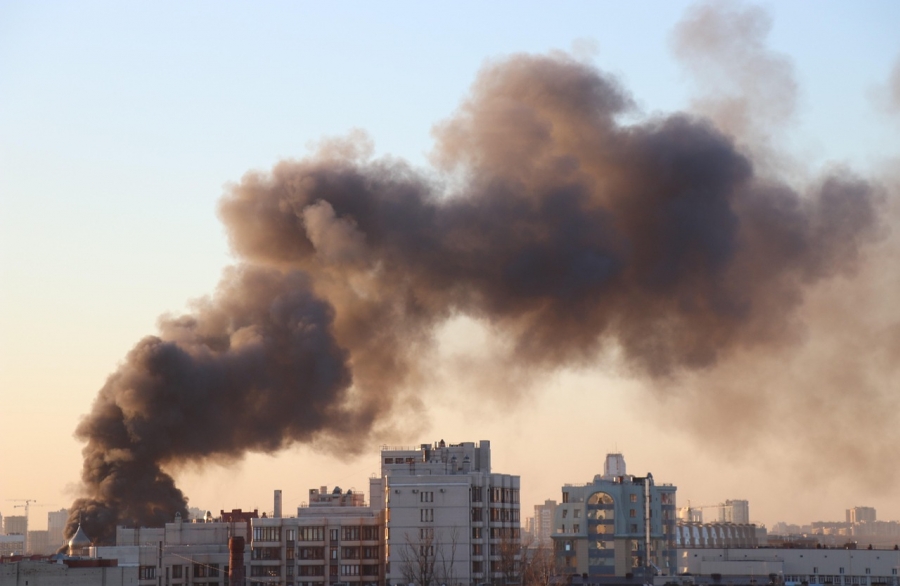
The Joint policy brief for the Second EWIPA Conference by the Norwegian People’s Aid, PAX, the Conflict and Environment Observatory and Geneva Water Hub addresses how explosive weapons have an encompassing destructive power, causing damages for both the population and the environment. The document (called “Mitigating environmental harm by implementing the EWIPA declaration”) offers guidelines to reduce direct and indirect harm to the ecosystem for States endorsing the EWIPA Declaration. The base principle is that prevention is essential to reduce harm a priori and to avoid high cost reconstruction operations, very difficult for States post-emergency context.
Firstly, pollution generated by explosive weapons is addressed. From the dispersion in the air of hazardous substances to the contamination of the soil and waters, the effects are wide-ranging. Waste materials created by the explosions are highly toxic as their dispersion in air, ground, waters, can render them unfit for consumption, cultivation, and inhalation. Contact with those substances by the population causes diseases and deaths which prove to be long-term. The direct material destruction of cities and urban areas weakens the system, unable to respond to the population affected, causing more fatalities.
Gaza and Ukraine are striking examples to understand such effects.
The use of explosive weapons in Gaza has generated 61 million tonnes of debris and 300,000 tonnes of solid garbage, most of them toxic for the population and the environment. More than 80% of buildings, infrastructure and agricultural land have been destroyed. It is the most targeted area since WWII. In Ukraine, debris amount to 100 million tonnes and around 15% of the housing stock of the country has been destroyed. In both cases, civilians are put at high risk due to the direct lethal effect of weapons, but also by the reverberating effects. The destruction of vital infrastructure such as hospitals, the intoxication of land (thus rendered unfit for cultivation), the creation of toxic waste that management systems are not able to dispose effectively (asbestos, heavy metals), the proliferation of toxins in the air, are just some of the striking effects that overburden civilians and the environment. The aforementioned consequences of explosive weapons reveal to be very dangerous, due to the fact that they are insidious and difficult to contain. Having unpredictable effects, they cause countless problems and deaths.
Reverberating effects are thus the focus of the joint policy brief, taking into consideration the clauses 3.1, 3.4 and 4.2 of the EWIPA Declaration. They are the improvement of national policy on the protection of civilians from direct and indirect effects of explosive weapons, the commitment to collect data on those same effects for the development of a comprehensive database and knowledge.
One of the case study reported focuses on the importance of safeguarding water resources, due to their essential role for survival for both humans and the ecosystem as a whole. Any attack by explosive weapons involving water resources has a huge impact on life, and reconstruction may result in costly and burdensome procedures. Cutting off water resources results in poor hygiene and development of diseases, as well as dehydration and lack of water for agriculture.
For all these reasons, creating a network of cooperating states is essential to guarantee a safety net and mutual support in prevention and aid.
To mitigate environmental harm, the policy brief identifies a set of recommendations to implement the EWIPA Declaration:
- when considering the effects of explosive weapons, states should include environmental declaration as point and planning military operations consequently; data collection is also a key action to better address the issue with appropriate policies
- UN Environment Assembly resolution 6.12 represents a tool to be followed since it provides environmental guidance
- endorsing States should harmonise their initiatives on environmental policy.
To know more, please visit:
https://paxforpeace.nl/wp-content/uploads/sites/2/2025/11/mitigating_environmental_harm25.pdf


