


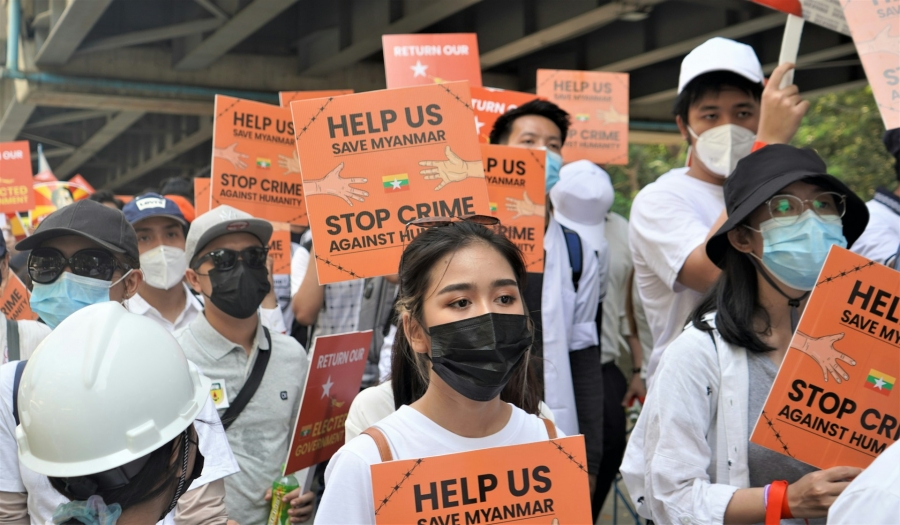
During the weekend of January 25–26, 2025, junta-led airstrikes in Myanmar struck a village in the Mandalay Region and a public hospital in Kyaukme, leaving at least 20 people dead and injuring dozens more.
On Saturday, January 25, a military aircraft dropped two bombs on a hospital in Kyaukme, a northern area of Shan State controlled by the Ta'ang National Liberation Army, an ethnic armed organization. The attack caused three deaths and at least 20 others injured. On the following day, January 26, a junta jet dropped two bombs over a pro-democracy militia group's office in Myingyaing Township within the Mandalay region, leaving 17 dead and eight wounded.
These attacks are part of a series of escalating military offensives. Earlier in the month, on January 8, 2025, the military conducted an airstrike on Kyauk Ni Maw village in Rakhine State–killing at least 40 civilians, injuring more than 20 others, and destroying over 500 homes.
Since the military coup in February 2021, which ousted the democratically elected government of Aung San Suu Kyi, the junta has increasingly employed airpower to suppress both pro-democracy movements and ethnic minority groups advocating for autonomy. Since its start, at least 3.2 million people have been internally displaced, with the junta's continued aggression worsening the already dire humanitarian conditions.
Despite the country's urgent need for international aid, the global response has been inadequate in recent years. Over the past decade, key international actors—including the United States, the European Union, and other governments—have imposed sanctions on military-controlled entities and banks, restricting the junta's access to aviation fuel for its airstrikes against resistance forces nationwide. However, these measures have failed to significantly impact the junta's military operations or determine its systematic targeting of civilians. The military continues to circumvent sanctions through alternative fuel sources and external networks, maintaining its ability for large-scale attacks. Meanwhile, humanitarian organizations face severe access restrictions, limiting their ability to provide aid and medical assistance to affected populations.
The escalating human rights violations in Myanmar stress the urgent need for a stronger and more coordinated international response. Experts warn that without more effective intervention—such as targeted economic restrictions, increased diplomatic pressure, and enhanced humanitarian support—the junta's campaign of violence is likely to continue unchecked.


