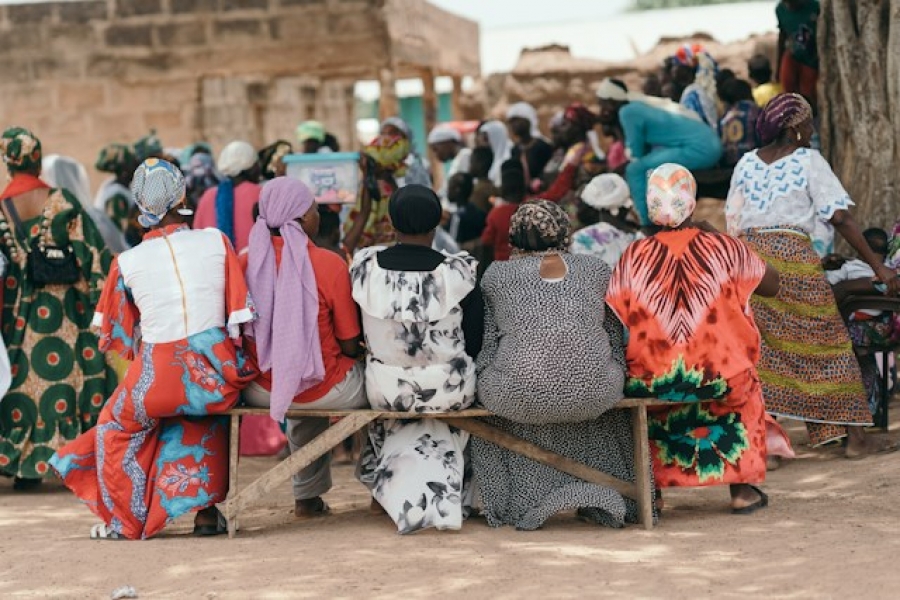
More than a dozen countries in Africa are actively experiencing armed conflict, which has contributed to devastating consequences for their societies. As a result, around 46 million people have been displaced, and 167 million face acute food insecurity. These conflicts are fueled by a strong societal basis, where ethnic, religious, or geographical differences are used to gain political traction. What is more, violent extremist groups contribute to the polarization of communities, causing a surge in reciprocal mistrust and fostering disillusionment. Most conflict resolution practices focus on elite negotiations and peace agreements between parties. However, the brief of the Africa Center for Strategic Studies, published in March 2026, shows that scaling community-level peacebuilding can positively help the mitigation and prevention of conflicts.
Community-level approaches
Interest-based mediation and negotiation (IBMN), which focuses on understanding why those interests exist in the first place instead of debating rigid demands, has proven to be particularly effective in finding workable agreements. IBMN is delivered in sessions with practical simulations, allowing leaders and communities to acquire practical skills to solve disputes.
In Nigeria, the Community Initiatives to Promote Peace (CIPP), a five-year peacebuilding and conflict-mitigation program funded by the United States Agency for International Development (USAID) and implemented by Mercy Corps alongside several local and regional partner organizations, operated across six northern states and covered 34 local government areas and hundreds of rural communities. The intervention through an IBMN training resolved over 1,900 communal disputes and reduced mistrust between groups.
Along the Kotido-Kaabong-Turkana West corridor in northern Uganda and Kenya, the training of 543 local leaders (which covered conflict analysis and mapping, IBMN, legal literacy, and community early warning and response) resulted in the creation of early-warning and response protocols between communities and administrations.
In a separate initiative in Nigeria, the Promoting Peaceful Communities around Elections (PPCE) programme strengthened conflict prevention by training security officials, judicial officers, and community leaders in interest-based mediation and nonviolent conflict resolution. The initiative aimed to address intercommunal grievances, improve relationships between citizens and security officials, and restore trust in local judicial institutions.
Within six months of implementation, communities reported a decrease in violence of 31 percent.
In Mali and Niger, the Justice and Stability in the Sahel (JASS) programme, funded by the United Kingdom with the aim of tackling underlying drivers of conflict linked to natural resources competition, established inclusive community resource committees involving farmers, women, and youth to address disputes over land and water. It incorporated IBMN training and facilitation to help resolve land and natural resources disputes. Subsequent findings showed that the intervention resolved 80-85 percent of disputes in the first year, and more than 200 local agreements were established concerning grazing corridors and water points.
Youth programs proved to be particularly effective in boosting dialogue and decreasing violence.
In the Maradi and Tillabéri regions of Niger, a youth program combined interest-based mediation and negotiation training with its core package of vocational training, entrepreneurship support, and civic education. It proved to be particularly effective compared to the economic and civic interventions alone. A later randomized control showed a decrease in violence acceptance, and villages that received the training experienced smaller increases in violence incidents.
In Kenya, the Collective Resilience Against Violent Extremism (CREATE) program, funded by the United Kingdom Foreign, Commonwealth and Development Office (FCDO) with the aim of reducing radicalization, combined vocational training, financial support, civic engagement, mentorship, psychosocial counselling, and community dialogue. Young people actively participated in designing programme activities and engaged in facilitated dialogue with peers and community leaders to address grievances, strengthen trust, and develop nonviolent conflict-resolution skills. Local mentors also supported participants in translating their acquired skills into employment opportunities, community service, and positive social roles.
Evaluations found significant reductions in radicalization, lower support for violence, and reduced willingness to join extremist groups.
Why it works
Community-based mediation, particularly IBMN, helps prevent conflict by rebuilding trust and strengthening cooperation between communities and authorities. It provides fair, accessible mechanisms for resolving disputes over resources, public services, and justice. In fragile settings where formal institutions are particularly weak, it can provide alternatives for non-violent conflict resolution. Furthermore, IBMN equips communities with skills to identify shared interests and negotiate mutually acceptable agreements. Mediation is not a replacement for security interventions; however, it can serve as a complementary approach and can focus on the root cause of the problem.
Recommendations
Scaling community-based conflict mediation requires moving beyond isolated initiatives and towards institutionalized and sustainable peacebuilding strategies. The brief’s evidence shows that IBMN can reduce violence by addressing underlying grievances. To scale IBMN effectively, it is pivotal for policymakers to make prevention and mitigation an explicit objective, to link local mechanisms to government systems to increase durability, and to engage with women, youth, and traditional and religious leaders to ensure participation of marginalized groups. A multilayered package should be preferred as proven to be more effective: mediation should be integrated with economic and civic programs, governance, security, and development initiatives.


