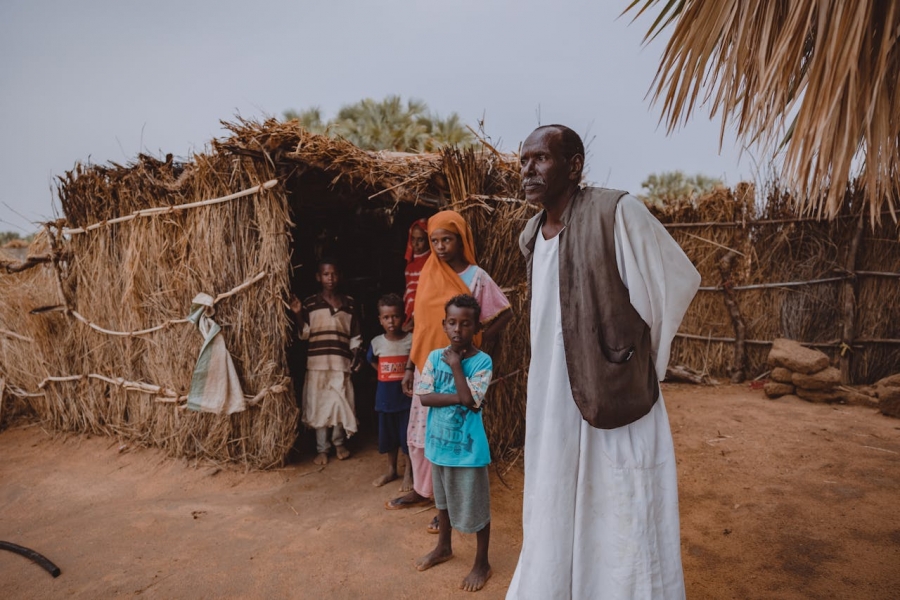
Over the past week, the paramilitary Rapid Support Forces (RSF) have killed more than 400 people in Sudan’s Darfur region during a brutal ground and aerial assault on refugee camps near the city of el-Fasher. The attacks appear to be an attempt to seize the last state capital in Darfur held by their rival, the Sudanese army. The two warring sides have been locked in a power struggle since April 2023, creating what the United Nations has declared as the world's largest humanitarian crisis.
The roots of this devastating conflict stretch back to Sudan’s 2018 popular uprising against long-time dictator Omar al-Bashir. In the aftermath, General Abdel Fattah al-Burhan, head of the Sudanese Armed Forces, and General Mohamed Hamdan Dagalo—known as Hemedti—leader of the RSF, initially allied to oust Bashir in April 2019. Their partnership continued in 2021 when they jointly removed a civilian-led transitional government that was meant to guide Sudan toward democracy. But tensions between the two leaders over control of the country quickly escalated, culminating in full-scale war in April 2023.
The RSF, which evolved from the Janjaweed militias responsible for atrocities during the early 2000s Darfur conflict, rapidly gained ground. As fighting spread from Khartoum into the Darfur region, RSF forces and allied militias launched brutal campaigns against non-Arab communities—particularly the Masalit—resulting in thousands of deaths and widespread reports of gang rape, forced pregnancies, and ethnic cleansing. In January 2025, the United States formally declared that the RSF had committed genocide, marking the second time in under 30 years that Sudan has faced such a charge. Both the RSF and the Sudanese army have been accused of war crimes, while international actors such as the United Arab Emirates have faced scrutiny for allegedly supplying arms to the RSF—a claim the UAE has denied.
15 April 2025 marked the two-year anniversary since the onset of the war that has since displaced over 12 million civilians inside and outside Sudan—more than half of them being women and children. Currently, it is estimated that more than 30 million individuals (64% of the Sudanese population) require assistance. However, as a result of the estimated 100 attacks on health facilities in the country, 80% are now partially functional (WHO). Consequently, this leaves roughly 70% of the population without access to any health services. In response, EMERGENCY Life Support for Civilian War Victims issued a statement from Laura Ena, nurse and Medical Coordinator of EMERGENCY’s Paediatric Centre in Nyala:
"Poor nutrition and a lack of safe drinking water are leading to more and more cases of gastroenteritis, infections, severe malnutrition and anaemia. I never saw children in such serious conditions before the start of this war. We are open seven days a week and 24 hours a day to meet everyone's needs."
Despite worsening conditions, efforts by international organizations and foreign governments to mediate Sudan's civil war remain fragmented and largely ineffective. A recent UK-hosted conference in London, aimed at establishing an international contact group to support ceasefire negotiations, ended without consensus after key Arab states—Egypt, Saudi Arabia, and the UAE—refused to sign a joint communiqué. Despite the setback, the UK, France, Germany, the African Union, and the EU issued a joint statement pledging to support peace efforts, reject external interference, and oppose any moves toward Sudan's partition.
UK Foreign Secretary David Lammy announced £120 million in new humanitarian aid, while Germany pledged €125 million to Sudan and neighboring countries. However, these funding efforts arose after the US's aid cuts, which groups like Mercy Corps say have already disrupted life-saving support for hundreds of thousands of people.
Civil society organizations, including Human Rights Watch, have criticized the failure to hold arms-supplying states accountable and warned that the international community is "sleepwalking into another genocide." Despite widespread condemnation of atrocities and rhetorical support for peace, neither the Sudanese army nor the RSF appears willing to enter negotiations, leaving regional and international bodies struggling to build a cohesive and actionable diplomatic front.


