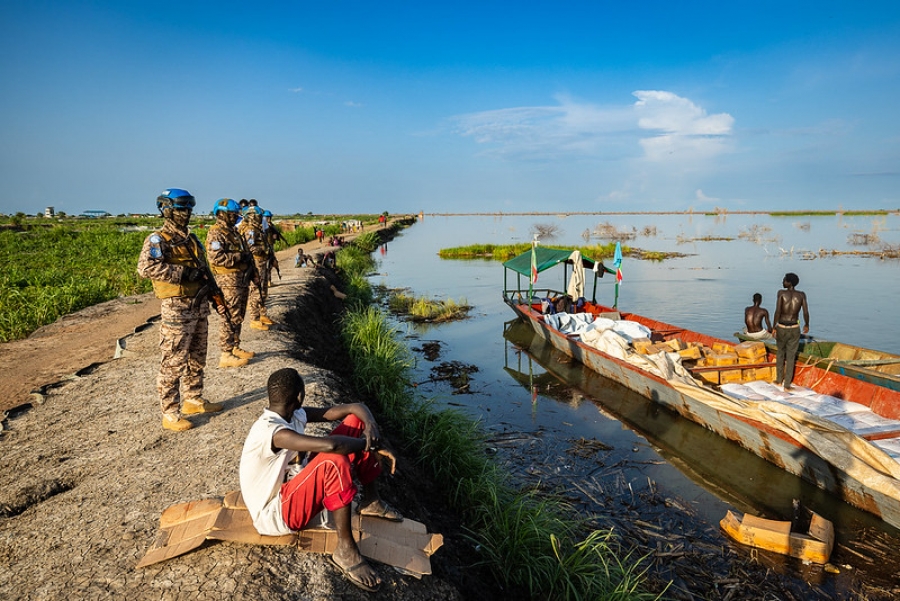
On 28 October 2024, South Sudan declared cholera a national emergency. The outbreak, the worst since the country’s independence in 2011, prompted the Ministry of Health to adopt a set of measures, in close coordination with key international partners including the World Health Organization (WHO) and UNICEF. One year later, despite some positive results and a decrease in weekly reports of cholera cases, experts wonder why the infection proved so difficult to be contained. Ilse De Boer, deputy medical coordinator for Doctors Without Borders (MSF) in South Sudan, has been monitoring the spread of the disease for over a year. In an Op-Ed published on the organisation’s website she suggests that the root causes of the outbreak should be searched in the root vulnerabilities that affect the country.
A one-year crisis
To date, around 95,000 suspected cases and more than 1,500 deaths have been reported across the country. At the peak of the crisis, in December 2024, an average of 1,000 cases were reported weekly. The outbreak spread across 55 counties in 9 States, reaching all 3 Administrative Areas. The swift response put in place by the Government helped drastically reduce case numbers. The measures included the deployment of rapid response teams, delivery of medical supplies, and coordination across all levels to maximise the effectiveness of interventions. As MSF’s deputy medical coordinator, Ilse De Boer was responsible for leading the organisation’s response to the outbreak. She managed the creation of cholera treatment units and centres to deliver timely treatment to the patients. In a few months, MSF’s intervention rapidly expanded in Upper Nile state, Unity state, and Juba, South Sudan’s capital, reaching over 35,000 people.
Dr. Humphrey Karamagi, WHO Representative for South Sudan, claimed that by September 2025 cases fell to less than 200 per week. Emphasising his optimism he stated that the recovery of cholera cases was at a promising 98%. According to Mr. Karamagi, the focus should now shift to implementing long-term health interventions to address the weak sanitary infrastructure in the country to build preparedness, preventive measures, and detective capabilities.
A symptom of deeper vulnerabilities
Despite the promising results, however, some experts still warn against premature optimism. According to Ms. De Boer, the real issue lies not in the medical treatment of cholera - on which there is no debate, as the procedure is well established - but rather in understanding why containment efforts have repeatedly failed. She claims that there are deeper causes to be taken into consideration and that the cholera outbreak isn’t but the latest symptom of these vulnerabilities: years of conflict and violence, systemic neglect, and an underfunded healthcare system weakening already fragile response capabilities.
Firstly, with little less than two per cent of the government's budget dedicated to health infrastructures, the country remains heavily dependent on external assistance. Recent cuts in international funding, like the withdrawal of support from USAID, has led to the closure of several health facilities, further undermining existing programmes. For example, in Bentiu, capital city of Unity State, people were left without access to basic aid following the reduction of funding to water and sanitation services.
Second, the arrival of thousands of individuals fleeing from neighbouring Sudan has increased the pressure on the assistance infrastructure, already strained by a lack of resources. Since the outbreak of the civil war between the Sudanese Armed Forces and the Rapid Support Forces in April 2023, more than 1 million refugees have crossed the border with South Sudan - equivalent to nearly 10 per cent of the country’s total population. The mass influx has led to overcrowding of transit camps, like the ones in Renk, which in some cases ended up hosting more than three times their capacity. Limited access to water and sanitation, coupled with the fact that the new arrivals are often excluded from essential services, including vaccination programmes, increased the risk of both contracting and spreading the disease. The precarious situation has led to a rise in other waterborne diseases, such as hepatitis E, which poses a severe health hazard, especially for pregnant women.
Thirdly, ongoing violence, insecurity, and extensive attacks on medical facilities further fuel instability. Since the beginning of 2025, MSF’s facilities have been directly targeted in more than eight attacks. One of the most significant instances occurred in March 2025, when fighting erupted near a MSF hospital in Ulang, which was later closed due to looting. Tens of individuals, including 30 patients who had been admitted for cholera treatment were forced to flee, with the risk of spreading the diseases within the community. A second hospital in Old Fangak in Jonglei state was forced to close, while numerous others had to suspend or scale down their activities.
The way forward
Highlighting the complexities of the current situation, Ms. De Boer warns the local government and the international community of the need for a unified and multi-sectoral response to the crisis in South Sudan. The partial and, unfortunately, insufficient measures that have been put in place so far, while necessary to address the most urgent repercussions of the emergency, will hardly prevent another outbreak.
Adequate funding must be focused on building emergency preparedness and response capacities. She calls on the responsibility of all stakeholders to prioritise service delivery to bring the much needed assistance to those most at risk.
As mentioned, with only a minimum percentage of the funding covered by the South Sudanese government and the strong reliance on external financing, renewed humanitarian and development support will be instrumental in building local resilience. It is imperative to ensure a more effective management of the limited resources now at the disposal of the communities, while at the same time working to close the gaps left by the most recent
funding cuts. These fundamental shifts are urgently needed to prevent new outbreaks from occurring.


