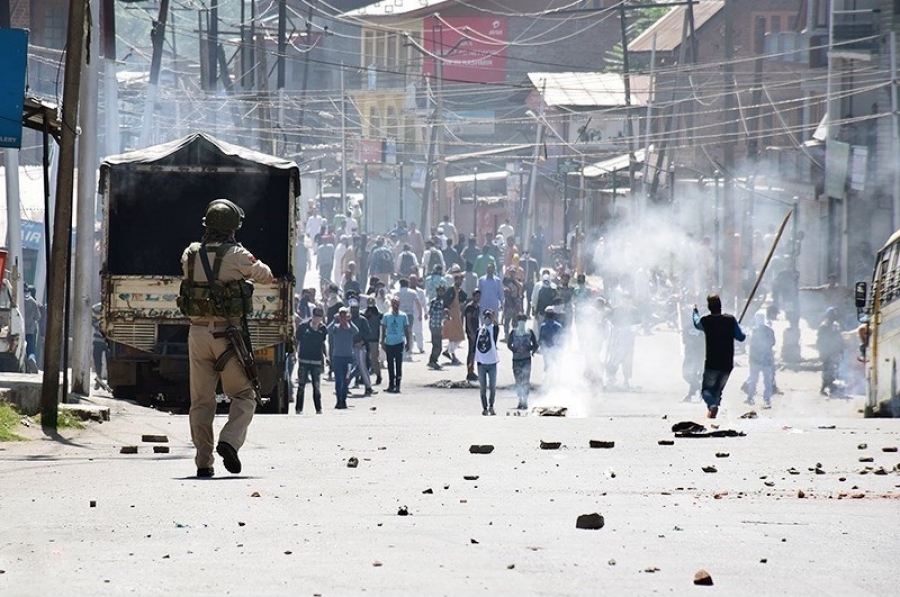
On 22 April, five armed militants launched an attack on tourists in the Baisaran Valley in the Kashmir region, resulting in the deaths of 26 civilians, including a Muslim pony rider who attempted to intervene in order to stop the violence. India has accused Pakistan of maintaining ties with the perpetrators of the act, an allegation that has been denied by Pakistan.
Al Jazeera reports that within 24 hours of the attack, a song was released on YouTube with the title "Pehle Dharam Pocha", which translates as "They asked about my religion first". The song in question explicitly targets Indian Muslims, accusing them of having conspired against Hindus and continuing to do so. Kavi Singh, a singer, has stated that the decision to allow Muslims to remain in India following the partition was erroneous, and that they should be permitted to return to Pakistan. The artist poses a question regarding the subject's allegiance to India, thereby inspiring a response from the audience in the form of the creation and dissemination of analogous musical compositions.
According to a report by Al Jazeera, at least 20 Hindutva pop songs, characterised by the nationalist ideology of the governing party, the Bharatiya Janata Party (BJP), have emerged online. These songs feature Islamophobic themes, labelling Indian Muslims as "traitors" and advocating for legitimate violence against them. It is also posited that the use of nuclear weapons against Pakistan, or the complete eradication of the nation, should be considered, as well as the shedding of "Pakistani blood". The Association for Protection of Civil Rights (APCR) documented 21 anti-Muslim attacks between 24th and 29th April. These attacks included evictions, assaults on street vendors, and denial of medical care in several Indian states, such as Uttar Pradesh, Haryana, Maharashtra, and Uttarakhand. The actions also included the violent mistreatment of Kashmiri women and students. The culmination of this animosity was the death of a Muslim man in Agra at the hands of a Hindu supremacist, who claimed retribution for the Pahalgam attack.
The roots of this antagonism can be traced back to the division of India and Pakistan in 1947, during the decolonization period following the Second World War. The former British colony is distinguished by the presence of three distinct religious groups: Hindus, Sikhs and Muslims. This religious diversity has been a contributing factor in the forced displacement of at least 15 million individuals, accompanied by widespread acts of violence. The civilian death toll resulting from the partition is estimated within the range of 200,000 to 2,000,000. The division was based on demographic reasons and was decided by the Boundary Commission, which was chaired by Sir Cyril Radcliffe. The formation of Pakistan occurred through the union of two regions: West Pakistan (present-day Pakistan) and East Pakistan (now Bangladesh). The formation of India occurred subsequent to the incorporation of the remaining regions. Conversely, the princely state of Jammu and Kashmir, which was predominantly Muslim while its ruler was Hindu, maintained a neutral stance. However, when armed groups from Pakistan invaded, the ruler requested Indian assistance and consented to join forces with India in return. This dynamic ultimately precipitated the first war between India and Pakistan, which culminated in a division of the region, with India acquiring the larger portion and Pakistan gaining a smaller portion. Subsequent to this, the region of Kashmir has remained a site of ongoing territorial and political discord between the two nations.
It is of the utmost importance that this episode be given greater coverage by the media, and that the international community identifies a means of bringing an end to these violent attacks.


